
Shruti Srivastava
DePaul University
HCI 450 | Foundations of Human Computer Interaction
Dr. Peter Hastings
11 November 2023
Abstract
This study critically looks at the ethical implications of persuasion in the subject of neurodesign, which combines design & cognitive theory with neuroscience. The evaluation centers on striking a careful balance between persuading people and honoring their independence. With a better understanding of the human brain, neurodesign has enormous potential to improve decision-making and problem-solving. But it also brings up important ethical questions, mainly about how much these technologies should affect how people behave. The review examines multiple viewpoints on the ethical use of neurotechnology, the benefits and drawbacks of persuasive technology, and design concepts that preserve user autonomy by drawing on a wide range of academic sources. The objective is to combine different points of view to offer a thorough grasp of the moral dilemmas raised by neurodesign and propose a framework for ethically responsible practices. It highlights how aesthetics and functionality are determined by scientific study rather than by subjective judgment.
The Ethics of Persuasion in Neurodesign: Balancing Influence and User Autonomy
The field of neurodesign, represents a major advancement in our understanding of and ability to influence user experiences. This multidisciplinary discipline makes use of neurotechnology innovations, including neurofeedback devices and brain-computer interfaces (BCIs), to learn more about how people react while interacting with designed objects and settings. With a richer understanding of human cognitive and emotional processes woven into the structure of our physical and digital places, these findings are changing the principles of design. The foundation for this integration has been established by recent advancements in neurotechnology, particularly in the areas of precise nerve cell stimulation and recording. Neurodesign expands its horizons beyond conventional design paradigms by utilizing these technological advances and providing a more sophisticated and data-driven method of comprehending user experiences. The work in this field by Paoletti (2021) is a prime example of neurodesign's potential. Neurodesign is an approach that connects cognitive neuroscience with real-world design applications by monitoring consumers' neurophysiological activity during product interactions. This method improves the effectiveness and attractiveness of design solutions by allowing designers to quantitatively evaluate and react to the emotional and cognitive states of consumers. But there are important ethical concerns with using neurotechnology in design. These worries cover a wide range, including how design affects individual autonomy and agency as well as privacy, consent, and user safety in such built environments. Neurodesign balances between having a positive impact and going too far in terms of ethics when it comes to improving or changing user experiences based on neurophysiological data.
The ethical difficulties in this area are brought to light by Illes and Etkin (2019), who draw attention to the possible discrepancy between the anticipated results and the practical applications of neurodesign treatments. This covers not only the effectiveness of these interventions but also their inadvertent psychological effects and the moral obligation of designers to use such potent instruments. The obstacles facing neurodesign as it develops are comparable to those facing neurotechnology, and they include the ethical ramifications of using invasive versus non-invasive techniques. Although neurodesign mostly uses non-invasive methods, careful application and ethical review are required due to the sensitivity and depth of the data involved.
It is essential to deal with the ethical difficulties in a proactive manner going forward. Informed consent, privacy protection, and fair access to neurodesign advancements are all part of this. Given that neurodesign can profoundly impact user behavior and experience, user-centered design principles, ethical responsibilities, and technology innovation must all be harmoniously combined in a balanced approach.
Literature Review
Understanding Neurodesign
Neurodesign represents the convergence of cognitive neuroscience and design. It harnesses neuroscientific tools to measure a user’s neurophysiological activities during a product experience. This approach provides valuable insights into the user’s affective and cognitive states, aiding in product development. The core objective is to find a functional link between neuroscience and design, where neuroscientific data informs and enhances the design process (Paoletti et al., 2021). The integration of neuroscience in design raises ethical concerns regarding user autonomy, privacy, and the potential manipulation of emotional states. The use of neurophysiological indices like the emotional index, which synthesizes valence and arousal, offers a profound understanding of the user’s emotional reactions but also poses ethical dilemmas about the extent and manner of its application in design. A balanced approach in neurodesign necessitates a careful alignment of neuroscientific insights with ethical design principles. This alignment should respect the user’s autonomy and consent, ensuring that the influence exerted through design does not cross into manipulation or coercion.
Neuroscientific Foundations of Persuasion in Neurodesign
Neurodesign uses our understanding of how the brain works to improve user experiences. It focuses on how people think, make decisions without being fully aware of it, and react emotionally to different designs. For example, by measuring emotional reactions, designers can see how users respond to a product without the users even realizing it. This approach is based on the idea that our minds work on three levels, as suggested by Don Norman: reflective (thinking), behavioral (doing), and visceral (feeling). Neurodesign aligns with these levels, helping designers create products that are not only appealing but also resonate with our subconscious mind. The emotional part, especially, is crucial because it shows how our basic feelings and habits shape how we interact with different designs. By understanding these emotional cues, designers can create products that not only look good but also fulfill our emotional and psychological needs. However, using these neuroscientific insights in design must be done ethically. Designers must make sure they enhance the user experience while still respecting the users' personal space and ability to make their own choices.
Ethics at the Core of Influence in Neurodesign
When it comes to influencing users through neurodesign, ethics is key. It's important to maintain the user's freedom to choose, to know the difference between ethical persuasion and manipulation, and to acknowledge the designer's responsibility. Preserving user autonomy means respecting their right to make decisions freely, without being overly swayed by the design of a product. The line between ethical persuasion and manipulation is fine but crucial. Persuasion should aim to improve the user experience without taking away the user's free will or taking advantage of their weaknesses. A health app that respects users' choices and uses an engaging design to persuade them to exercise more is an example of ethical persuasion in neurodesign. On the other hand, manipulation might be when a game uses components of an addictive design to entice players to play longer, so impairing their capacity to make independent judgments.
Ethical dilemmas: Navigating the Grey Areas
Ethical conundrums in the developing field of neurodesign mostly center on the delicate balancing act between informed permission, privacy, and user-designer trust. The intricacy stems from the essence of neurodesign, which entails gathering delicate neurophysiological information to improve design procedures.
Paoletti et al (2021) point out that neurodesign uses cognitive neuroscience to evaluate users' neurophysiological activity during product encounters using noninvasive methods. This method is useful for comprehending the affective and cognitive states of users, which are frequently represented in indices such as the emotional index. The extent to which user data can be gathered and analyzed creates important ethical concerns, even while this data is crucial for product development. The difficulty is in striking a careful balance between the need to protect individual privacy and to gain comprehensive insights into human behavior. The informed consent principle lies at the core of these privacy concerns. Users must be properly informed about the type of data being gathered, how it will be used, and any possible repercussions from that usage. Informed permission guarantees that participants are not unintentionally subjected to privacy invasions or manipulations based on their neurophysiological data, while still being in line with the ideals of autonomy and privacy. The sensitivity of neurophysiological data makes the right to digital privacy in neurodesign especially complicated. Such information can provide personal facts on the mental and emotional health of a person. It is crucial to make sure that this data is protected and used ethically, which emphasizes the necessity to respect and preserve people's right to privacy. In neurodesign, the user-designer relationship is based on openness and trust at the same time. Transparency in the use of tools such as eye-trackers and other devices that assess neurophysiological responses is crucial. It is important to make users aware of the consequences of these metrics. For neurodesign to be used ethically and successfully, trust must be built through open communication and openness.
Social Media and Neurotechnology Representations
The goal of Purcell-Davis' 2013 study, "The Representations of Novel Neurotechnologies in Social Media: Five Case Studies," was to provide light on the social media discussions around emerging neurotechnologies. It was commissioned as part of the endeavor to create an ethical framework for cutting-edge neurotechnologies by the Nuffield Council on Bioethics. The study examined content on blogs, Delicious, Twitter, Facebook, YouTube, and other social media sites with an emphasis on neural stem cell therapy, deep brain stimulation, and brain computer interface.
The study's main conclusions showed that social media provided a forum for a variety of views, including those of patients, medical professionals, and neuroscientists. This variety of viewpoints was essential to comprehending the complex nature of cutting-edge neurotechnologies. The investigation also discovered evidence of the marketing and promotion of these technologies as possible medical interventions, the exaggeration of scientific discoveries, and the optimism for the treatment of neurodegenerative illnesses. These results emphasized social media's influence on public opinion and conversation about developing medical innovations, both positively and negatively.
The Moral Trust Test: Measuring Ethical Design
An ethical framework is becoming more and more important, especially in the field of persuasive technologies, as neurodesign is increasingly incorporated into daily technologies. The ability of neurodesign to affect user behavior and decision-making raises important concerns regarding the moral limits of this influence, which serves as justification for its necessity. A key idea in this context is the Moral Trust Test as explained by Brennan (2021), which attempts to gauge and guarantee ethical adherence in the development and application of neurotechnologies. Fundamentally, the Moral Trust Test is based on the idea that moral design needs to be in line with society values and personal autonomy in addition to legal requirements. This test assesses neurotechnological applications based on a number of criteria, such as the avoidance of undue manipulation, transparency of purpose, and respect for user autonomy. It requires striking a balance between the retention of user agency and the potency of persuasive features to guarantee that the influence that neurodesign exerts is morally and responsibly done.
Practically speaking, the Moral Trust Test entails a number of assessments and benchmarks during the design phase. The possible effects of designers' and developers' work on user autonomy and decision-making must be carefully considered. Examining the finer points of how neurotechnological tools affect user behavior is necessary to make sure that these interventions are clear to users and compliant with their informed consent. But there are difficulties in putting the Moral Trust Test into practice. One of the main issues is that ethical standards are dynamic and frequently subjective, and they can change over time and across cultural boundaries. Moreover, the fast advancement of neurotechnology frequently surpasses the creation of moral standards, leaving a gap that might be challenging to close. Additionally, there is a chance that overly stringent regulations will impede innovation and the potential advantages of neurodesign.
Future Directions
To tackle the issues raised by the requirement for thorough ethical standards in neurodesign, I suggest a specific framework designed specifically for product developers, marketing directors, and designers in mind. It is intended to serve as a guide for these experts as they develop products that, at different phases of development, conform to ethical neurodesign principles.
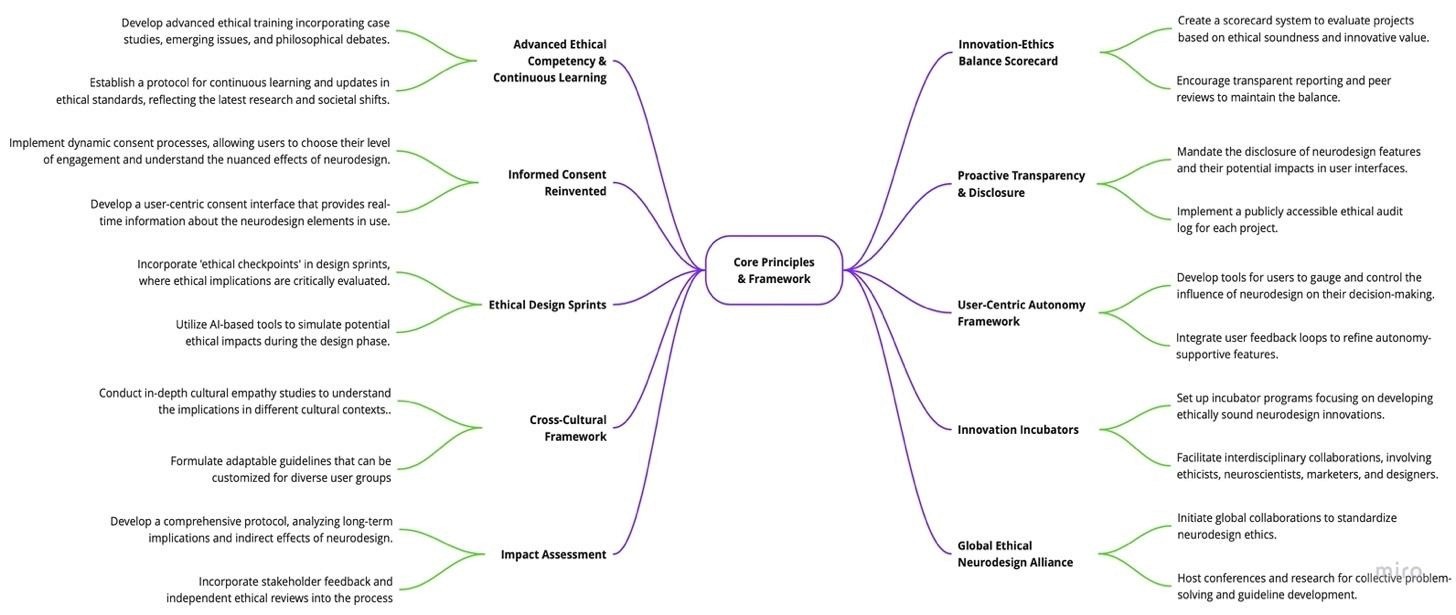
Figure 1: Proposed Framework
The purple branches guide product creators on ethical compliance and innovation at each development stage, while the green branches detail specific actions for designers during each stage.
Conclusion
It is evident that moral issues play a critical role in the creation and use of neurodesign technology. Together, the research by credible authors demonstrate how neurodesign can improve decision-making while highlighting the necessity of ethical frameworks to protect user autonomy and avoid manipulation. As innovators, this ethical intersection of Neurodesign presents a revolutionary approach to understanding user experiences. A key takeaway is the need for consistency across various sensory channels to align with a product's primary function, ensuring a harmonious user experience. Engaging multiple senses can make our designs more impactful and memorable. The case studies in the research, using neurophysiological data to validate design choices, underscore the value of empirical evidence in creating resonant designs. Maintaining user autonomy, informed consent, and privacy is imperative. Integrating these ethical considerations with agile methodologies can ensure that our designs are not only innovative and engaging but also ethically sound.
References
Balters, Weinstein, T., Mayseless, N., Auernhammer, J., Hawthorne, G., Steinert, M., Meinel, C., Leifer, L. J., & Reiss, A. L. (2023). Design science and neuroscience: A systematic review of the emergent field of Design Neurocognition. Design Studies, 84, 101148–. https://doi.org/10.1016/j.destud.2022.101148
Bikson, & Giordano, J. (2023). Defining distinction between real vs hypothetical problems in the ethics of neurotechnology. Brain Stimulation, 16(3), 977–979. https://doi.org/10.1016/j.brs.2023.05.016
Brennan. (2021). Trust as a Test for Unethical Persuasive Design. Philosophy & Technology, 34(4), 767–783. https://doi.org/10.1007/s13347-020-00431-6
Fogg, B. J. (2003). Persuasive technology: Using computers to change what we think and do. Amsterdam: Morgan Kaufmann Publishers. https://searchworks.stanford.edu/view/5476898
Höök. (2021). Why mess with users’ autonomy? On ideals and dualism in design. Human-Computer Interaction, 36(5-6), 394–399. https://doi.org/10.1080/07370024.2020.1819281
Jarchum. (2019). The ethics of neurotechnology. Nature Biotechnology, 37(9), 993–996. https://doi.org/10.1038/s41587-019-0239-3
Liu, Jin, Y., Li, B., Lyu, Z., Pan, W., Wang, N., & Zhao, X . NeuroDesign: Making Decisions and Solving Problems Through Understanding of the Human Brain. In Design, User Experience, and Usability. Interaction Design (pp. 199–208). Springer International Publishing. https://doi.org/10.1007/978-3-030-49713-2_14
Paoletti, & Imbesi, L. (2021). A Neurodesign Case Study: Measuring the Emotional Index for Redesign. Design Principles & Practices, 15(1), 33–44. https://doi.org/10.18848/1833-1874/CGP/v15i01/33-44
Purcell-Davis. (2013). The Representations of Novel Neurotechnologies in Social Media: Five Case Studies. The New Bioethics, 19(1), 30–45. https://doi.org/10.1179/2050287713Z.00000000026
.thinking behind the work